Groups get further than individuals.
Farming groups, women's groups, savings groups, youth groups and cooperatives are the structures YOCED works through most effectively — because they already carry the trust and the organisation that a program otherwise has to build from nothing.
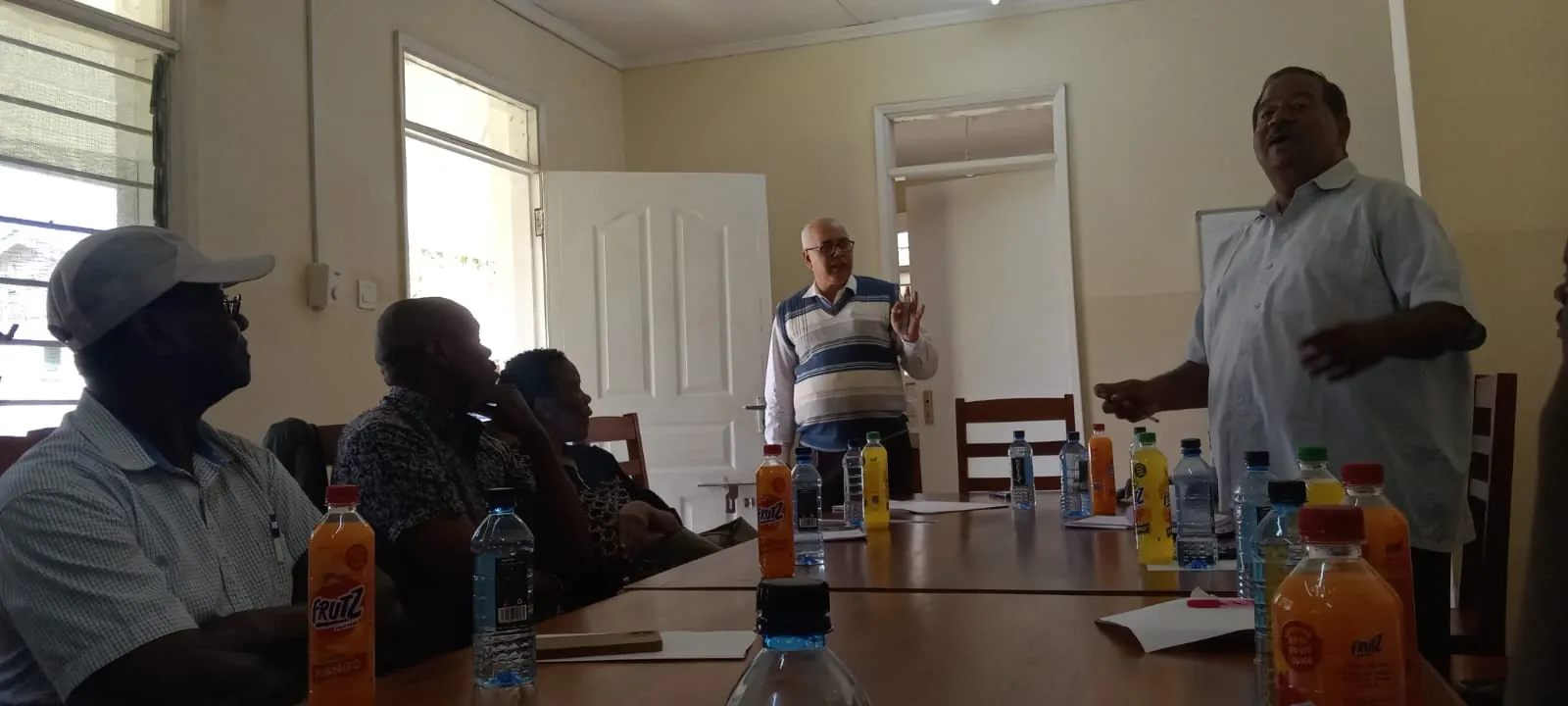
Concretely, this.
- 01Group trainingTraining and mobilisation sessions built around what the group is actually trying to do.
- 02Production organisationCoordinating land preparation, planting, harvest and post-harvest handling at a scale an individual household cannot reach.
- 03Shared accessMechanisation, inputs and processing that only make sense when a group shares them.
- 04Group financeWorking with savings and rotating structures the group already uses, rather than replacing them.
Why groups
A tractor pass, a drying floor and a processing step are all uneconomic for one household and straightforward for fifteen. The same is true of a buyer relationship: nobody contracts with a single smallholder, and everybody will talk to an organised group with consistent output.
Groups also carry accountability that programs cannot manufacture. Where a group already functions, work started with it tends to survive after the program ends.
Women's and community groups
Much of YOCED's women and community work runs through existing groups, because they are the setting where issues around income, safety, health and education can be raised at all.
Where a matter needs professional support — clinical, legal, protection — YOCED's role is to connect the group to a partner qualified to provide it.
What YOCED asks
That the group is genuinely functioning, with people who show up and some way of making decisions together. It does not need to be registered or formal.
And that the group is clear about what it wants. A group with a specific objective gets a specific program; a group without one gets a conversation first.
What makes the first message useful.
- How many people are actively involved
- What the group already does together
- Where you are located
- The specific thing you want to change
Where to start in the atlas.
Contact YOCED.
The inquiry form routes by topic, so this reaches the right part of YOCED without going through a general inbox first.
The other four routes.
- 01I am looking for skills, work or a way in.YOCED is not a place to register and wait. The routes below all connect to something that is already running — a field operation, a venture, a training cycle, a venture that needs people.Youth
- 02I have a business, or the beginning of one.YOCED's enterprise support starts with the operational layer under your business — process, costing, records — because that is what determines whether it can grow, be delegated, or be funded.Entrepreneurs
- 03My organisation works in one of these fields.You do not have to engage with all of YOCED to work with YOCED. Each of the thirteen fields has its own page, its own partnership models and its own route in — and each one is built to be sent to a colleague on its own.Partners
- 04I am assessing whether YOCED is fundable.This page exists because due diligence deserves a straight answer. Here is what YOCED can document, where the gaps are, and what a first engagement would sensibly look like.Funders